
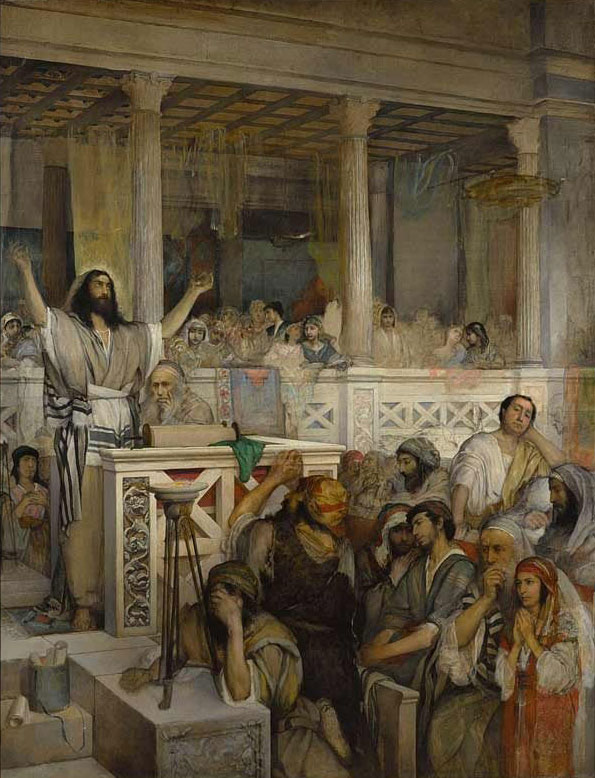
4th Sunday in Ordinary Time, Year B
El Cuarto Domingo de Tiempo Ordinario
January 28th, 2024
Feast Day: 4th-ot-b
Psalms / Salmos
Entrance Antiphon
Save us, O Lord our God!
And gather us from the nations,
to give thanks to your holy name,
and make it our glory to praise you.
(Psalm 106:47)
Antífona de Entrada
Sálvanos, Señor y Dios nuestro;
reúnenos de entre las naciones,
para que podamos agradecer tu poder santo
y nuestra gloria sea alabarte.
(Salmo 105, 47)
First Reading
Deuteronomy 18:15-20
Moses spoke to all the people, saying:
“A prophet like me will the LORD, your God, raise up for you
from among your own kin;
to him you shall listen.
This is exactly what you requested of the LORD, your God, at Horeb
on the day of the assembly, when you said,
‘Let us not again hear the voice of the LORD, our God,
nor see this great fire any more, lest we die.’
And the LORD said to me, ‘This was well said.
I will raise up for them a prophet like you from among their kin,
and will put my words into his mouth;
he shall tell them all that I command him.
Whoever will not listen to my words which he speaks in my name,
I myself will make him answer for it.
But if a prophet presumes to speak in my name
an oracle that I have not commanded him to speak,
or speaks in the name of other gods, he shall die.'”
Primera Lectura
Deuteronomio 18, 15-20
En aquellos días, habló Moisés al pueblo, diciendo: El Señor Dios hará surgir en medio de ustedes, entre sus hermanos, un profeta como yo. A él lo escucharán. Eso es lo que pidieron al Señor, su Dios, cuando estaban reunidos en el monte Horeb: No queremos volver a oír la voz del Señor nuestro Dios, ni volver a ver otra vez ese gran fuego; pues no queremos morir.
El Señor me respondió: Está bien lo que han dicho. Yo haré surgir en medio de sus hermanos un profeta como tú. Pondré mis palabras en su boca y él dirá lo que le mande yo. A quien no escuche las palabras que él pronuncie en mi nombre, yo le pediré cuentas. Pero el profeta que se atreva a decir en mi nombre lo que yo no le haya mandado, o hable en nombre de otros dioses, será reo de muerte .
Responsorial Psalm
Psalm 95:1-2, 6-7, 7-9
Response:
If today you hear his voice, harden not your hearts.
Verse 1:
Come, let us sing joyfully to the LORD;
let us acclaim the rock of our salvation.
Let us come into his presence with thanksgiving;
let us joyfully sing psalms to him.
Verse 2:
Come, let us bow down in worship;
let us kneel before the LORD who made us.
For he is our God,
and we are the people he shepherds, the flock he guides.
Verse 3:
Oh, that today you would hear his voice:
“Harden not your hearts as at Meribah,
as in the day of Massah in the desert,
where your fathers tempted me;
they tested me though they had seen my works.”
Salmo Responsorial
Salmo 94, 1-2. 6-7. 8-9
Respuesta:
Ojalá escuchen hoy su voz: “No endurezcan el corazón.”
Estrofa 1:
Vengan, aclamemos al Señor,
demos vítores a la Roca que nos salva;
entremos a su presencia dándole gracias,
vitoreándolo al son de instrumentos.
Estrofa 2:
Entren, postrémonos por tierra,
bendiciendo al Señor, creador nuestro.
Porque él es nuestro Dios
y nosotros su pueblo,
el rebaño que él guía.
Estrofa 3:
Ojalá escuchen hoy su voz:
No endurezcan el corazón como en Meribá,
como el día de Masá en el desierto,
cuando los padres de ustedes me pusieron a prueba
y me tentaron, aunque habían visto mis obras.
Second Reading
1 Corinthians 7:32-35
Brothers and sisters:
I should like you to be free of anxieties.
An unmarried man is anxious about the things of the Lord,
how he may please the Lord.
But a married man is anxious about the things of the world,
how he may please his wife, and he is divided.
An unmarried woman or a virgin is anxious about the things of the Lord,
so that she may be holy in both body and spirit.
A married woman, on the other hand,
is anxious about the things of the world,
how she may please her husband.
I am telling you this for your own benefit,
not to impose a restraint upon you,
but for the sake of propriety
and adherence to the Lord without distraction.
Segunda Lectura
1 Corintios 7, 32-35
Hermanos: Yo quisiera que ustedes vivieran sin preocupaciones. El hombre soltero se preocupa de las cosas del Señor y de cómo agradarle;
en cambio, el hombre casado se preocupa de las cosas de esta vida y de cómo agradarle a su esposa, y por eso tiene dividido el corazón. En la misma forma, la mujer que ya no tiene marido y la soltera se preocupan de las cosas del Señor y se pueden dedicar a él en cuerpo y alma. Por el contrario, la mujer casada se preocupa de las cosas de esta vida y de cómo agradarle a su esposo.
Les digo todo esto para bien de ustedes. Se lo digo, no para ponerles una trampa, sino para que puedan vivir constantemente y sin distracciones en presencia del Señor, tal como conviene.
Gospel Acclamation
Matthew 4:16
The people who sit in darkness have seen a great light;
on those dwelling in a land overshadowed by death,
light has arisen.
Aclamación antes del Evangelio
Mateo 4, 16
Al pueblo postrado en tinieblas lo iluminó una luz grande.
Estaban sentados en la región sombría de la muerte,
pero apareció para ellos una luz.
Gospel
Mark 1:21-28
Then they came to Capernaum,
and on the sabbath Jesus entered the synagogue and taught.
The people were astonished at his teaching,
for he taught them as one having authority and not as the scribes.
In their synagogue was a man with an unclean spirit;
he cried out, “What have you to do with us, Jesus of Nazareth?
Have you come to destroy us?
I know who you arethe Holy One of God!”
Jesus rebuked him and said,
“Quiet! Come out of him!”
The unclean spirit convulsed him and with a loud cry came out of him.
All were amazed and asked one another,
“What is this?
A new teaching with authority.
He commands even the unclean spirits and they obey him.”
His fame spread everywhere throughout the whole region of Galilee.
Evangelio
Marcos 1, 21-28
En aquel tiempo, se hallaba Jesús en Cafarnaúm y el sábado fue a la sinagoga y se puso a enseñar. Los oyentes quedaron asombrados de sus palabras, pues enseñaba como quien tiene autoridad y no como los escribas.
Había en la sinagoga un hombre poseído por un espíritu inmundo, que se puso a gritar: ¿Qué quieres tú con nosotros, Jesús de Nazaret? ¿Has venido a acabar con nosotros? Ya sé quién eres: el Santo de Dios. Jesús le ordenó: ¡Cállate y sal de él! El espíritu inmundo, sacudiendo al hombre con violencia y dando un alarido, salió de él. Todos quedaron estupefactos y se preguntaban: ¿Qué es esto? ¿Qué nueva doctrina es ésta? Este hombre tiene autoridad para mandar hasta a los espíritus inmundos y lo obedecen. Y muy pronto se extendió su fama por toda Galilea.
Offertory Antiphon
It is good to give praise to the Lord,
and to sing to your Name, O Most High.
(Psalm 92:2)
Antífona de Ofertorio
Es bueno dar gracias al Señor,
y salmodiar a tu nombre, oh, Altísimo.
(Salmo 91, 2)
Communion Antiphon
Let your face shine on your servant.
Save me in your merciful love.
O Lord, let me never be put to shame, for I call on you.
(Psalm 31:17-18)
Communion Antiphon 2
Blessed are the poor in spirit,
for theirs is the Kingdom of Heaven.
Blessed are the meek, for they shall possess the land.
(Matthew 5:3-4)
Antífona de Comunión
Vuelve, Señor, tus ojos a tu siervo
y sálvame por tu misericordia.
A ti, Señor, me acojo, que no quede yo nunca defraudado.
(Salmo 30, 17.18)
Antífona de Comunión 2
Dichoso los pobres de espíritu,
porque de ellos es el Reino de los cielos.
Dichosos los humildes,
porque heredarán la tierra.
(Mateo 5, 3-4)
Lectionary for Mass in the Dioceses of the United States of America, volume I Copyright © 1970, 1997, 1998 Confraternity of Christian Doctrine, Inc., Washington, D.C. All rights reserved. No part of this work may be reproduced or transmitted in any form or by any means, electronic or mechanical, including photocopying, recording, or by any information storage and retrieval system, without permission in writing from the copyright owner.
© 1999 Comisión Episcopal de Pastoral Litúrgica Derechos reservados a favor de OBRA NACIONAL DE LA BUENA PRENSA, A.C. Apartado M-2181. 06000 México, D.F. Orozco y Berra 180. Santa Mariá la Ribera.
© 1970 Comisión Episcopal Española de Liturgia
© 1972 SOBICAIN. Derechos reservados.