
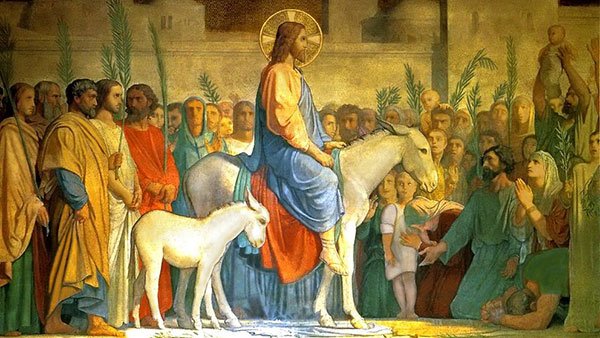
Palm Sunday, Year B
Domingo de Ramos, Año B
March 24th, 2024
Feast Day: palm-sunday-b
Psalms / Salmos
Entrance Antiphon
Hosanna to the Son of David,
the King of Israel.
Blessed is he who comes in the name of the Lord.
Hosanna in the highest.
(Matthew 21:9)
Antífona de Entrada
Hosanna al Hijo de David.
Bendito el que viene en nombre del Señor,
el Rey de Israel.
Hosanna en el cielo.
(Mateo 21, 9)
Antífona de Entrada (Gradual Romano)
¡Hosanna, al Hijo de David!
Bendito el que viene en el nombre del Señor.
¡Rey de Israel, Hosanna en el cielo!
(Mateo 21, 9)
First Reading
Isaiah 50:4-7
The Lord GOD has given me
a well-trained tongue,
that I might know how to speak to the weary
a word that will rouse them.
Morning after morning
he opens my ear that I may hear;
and I have not rebelled,
have not turned back.
I gave my back to those who beat me,
my cheeks to those who plucked my beard;
my face I did not shield
from buffets and spitting.
The Lord GOD is my help,
therefore I am not disgraced;
I have set my face like flint,
knowing that I shall not be put to shame.
Primera Lectura
Isaías 50, 4-7
En aquel entonces, dijo Isaías: El Señor me ha dado una lengua experta, para que pueda confortar al abatido con palabras de aliento. Mañana tras mañana, el Señor despierta mi oído, para que escuche yo, como discípulo. El Señor Dios me ha hecho oír sus palabras y yo no he opuesto resistencia ni me he echado para atrás. Ofrecí la espalda a los que me golpeaban, la mejilla a los que me tiraban de la barba. No aparté mi rostro de los insultos y salivazos. Pero el Señor me ayuda, por eso no quedaré confundido, por eso endurecí mi rostro como roca y sé que no quedaré avergonzado.
Responsorial Psalm
Psalm 22:8-9, 17-18, 19-20, 23-24
Response:
My God, my God, why have you abandoned me?
Verse 1:
All who see me scoff at me;
they mock me with parted lips, they wag their heads:
“He relied on the LORD; let him deliver him,
let him rescue him, if he loves him.”
Verse 2:
Indeed, many dogs surround me,
a pack of evildoers closes in upon me;
They have pierced my hands and my feet;
I can count all my bones.
Verse 3:
They divide my garments among them,
and for my vesture they cast lots.
But you, O LORD, be not far from me;
O my help, hasten to aid me.
Verse 4:
I will proclaim your name to my brethren;
in the midst of the assembly I will praise you:
“You who fear the LORD, praise him;
all you descendants of Jacob, give glory to him;
revere him, all you descendants of Israel!”
Salmo Responsorial
Salmo 21, 8-9. 17-18a. 19-20. 23-24
Respuesta:
Dios mío, Dios mío, ¿por qué me has abandonado?
Estrofa 1:
Al verme se burlan de mí,
hacen visajes, menean la cabeza:
Acudió al Señor, que lo ponga a salvo;
que lo libre si tanto lo quiere.
Estrofa 2:
Me acorrala una jauría de mastines,
me cerca una banda de malhechores:
me taladran las manos y los pies,
puedo contar mis huesos.
Estrofa 3:
Se reparten mi ropa,
echan a suerte mi túnica.
Pero tú, Señor, no te quedes lejos;
fuerza mía, ven corriendo a ayudarme.
Estrofa 4:
Contaré tu fama a mis hermanos,
en medio de la asamblea te alabaré.
Fieles del Señor, alábenlo,
linaje de Jacob, glorifíquenlo,
témanle, linaje de Israel.
Second Reading
Philippians 2:6-11
Christ Jesus, though he was in the form of God,
did not regard equality with God
something to be grasped.
Rather, he emptied himself,
taking the form of a slave,
coming in human likeness;
and found human in appearance,
he humbled himself,
becoming obedient to the point of death,
even death on a cross.
Because of this, God greatly exalted him
and bestowed on him the name
which is above every name,
that at the name of Jesus
every knee should bend,
of those in heaven and on earth and under the earth,
and every tongue confess that
Jesus Christ is Lord,
to the glory of God the Father.
Segunda Lectura
Filipenses 2, 6-11
Cristo, siendo Dios,
no consideró que debía aferrarse
a las prerrogativas de su condición divina,
sino que, por el contrario, se anonadó a sí mismo,
tomando la condición de siervo,
y se hizo semejante a los hombres.
Así, hecho uno de ellos, se humilló a sí mismo
y por obediencia aceptó incluso la muerte,
y una muerte de cruz.
Por eso Dios lo exaltó sobre todas las cosas
y le otorgó el nombre que está sobre todo nombre,
para que, al nombre de Jesús, todos doblen la rodilla en el cielo,
en la tierra y en los abismos,
y todos reconozcan públicamente que Jesucristo es el Señor,
para gloria de Dios Padre.
Gospel Acclamation
Philippians 2:8-9
Christ became obedient to the point of death,
even death on a cross.
Because of this, God greatly exalted him
and bestowed on him the name which is above every name.
Aclamación antes del Evangelio
Filipenses 2, 8-9
Cristo por nosotros se hizo obediente hasta la muerte
y muerte en una cruz.
Por eso Dios lo engrandeció
y le concedió el Nombre-sobre-todo-nombre.
Gospel
Mark 14:1 - 15:47
The Passion of our Lord Jesus Christ according to Mark
The Passover and the Feast of Unleavened Bread
were to take place in two days’ time.
So the chief priests and the scribes were seeking a way
to arrest him by treachery and put him to death.
They said, “Not during the festival,
for fear that there may be a riot among the people.”
When he was in Bethany reclining at table
in the house of Simon the leper,
a woman came with an alabaster jar of perfumed oil,
costly genuine spikenard.
She broke the alabaster jar and poured it on his head.
There were some who were indignant.
“Why has there been this waste of perfumed oil?
It could have been sold for more than three hundred days’ wages
and the money given to the poor.”
They were infuriated with her.
Jesus said, “Let her alone.
Why do you make trouble for her?
She has done a good thing for me.
The poor you will always have with you,
and whenever you wish you can do good to them,
but you will not always have me.
She has done what she could.
She has anticipated anointing my body for burial.
Amen, I say to you,
wherever the gospel is proclaimed to the whole world,
what she has done will be told in memory of her.”
Then Judas Iscariot, one of the Twelve,
went off to the chief priests to hand him over to them.
When they heard him they were pleased and promised to pay him money.
Then he looked for an opportunity to hand him over.
On the first day of the Feast of Unleavened Bread,
when they sacrificed the Passover lamb,
his disciples said to him,
“Where do you want us to go
and prepare for you to eat the Passover?”
He sent two of his disciples and said to them,
“Go into the city and a man will meet you,
carrying a jar of water.
Follow him.
Wherever he enters, say to the master of the house,
‘The Teacher says, “Where is my guest room
where I may eat the Passover with my disciples?”‘
Then he will show you a large upper room furnished and ready.
Make the preparations for us there.”
The disciples then went off, entered the city,
and found it just as he had told them;
and they prepared the Passover.
When it was evening, he came with the Twelve.
And as they reclined at table and were eating, Jesus said,
“Amen, I say to you, one of you will betray me,
one who is eating with me.”
They began to be distressed and to say to him, one by one,
“Surely it is not I?”
He said to them,
“One of the Twelve, the one who dips with me into the dish.
For the Son of Man indeed goes, as it is written of him,
but woe to that man by whom the Son of Man is betrayed.
It would be better for that man if he had never been born.”
While they were eating,
he took bread, said the blessing,
broke it, and gave it to them, and said,
“Take it; this is my body.”
Then he took a cup, gave thanks, and gave it to them,
and they all drank from it.
He said to them,
“This is my blood of the covenant,
which will be shed for many.
Amen, I say to you,
I shall not drink again the fruit of the vine
until the day when I drink it new in the kingdom of God.”
Then, after singing a hymn,
they went out to the Mount of Olives.
Then Jesus said to them,
“All of you will have your faith shaken, for it is written:
I will strike the shepherd,
and the sheep will be dispersed.’
But after I have been raised up,
I shall go before you to Galilee.”
Peter said to him,
“Even though all should have their faith shaken,
mine will not be.”
Then Jesus said to him,
“Amen, I say to you,
this very night before the cock crows twice
you will deny me three times.”
But he vehemently replied,
“Even though I should have to die with you,
I will not deny you.”
And they all spoke similarly.
Then they came to a place named Gethsemane,
and he said to his disciples,
“Sit here while I pray.”
He took with him Peter, James, and John,
and began to be troubled and distressed.
Then he said to them, “My soul is sorrowful even to death.
Remain here and keep watch.”
He advanced a little and fell to the ground and prayed
that if it were possible the hour might pass by him;
he said, “Abba, Father, all things are possible to you.
Take this cup away from me,
but not what I will but what you will.”
When he returned he found them asleep.
He said to Peter, “Simon, are you asleep?
Could you not keep watch for one hour?
Watch and pray that you may not undergo the test.
The spirit is willing but the flesh is weak.”
Withdrawing again, he prayed, saying the same thing.
Then he returned once more and found them asleep,
for they could not keep their eyes open
and did not know what to answer him.
He returned a third time and said to them,
“Are you still sleeping and taking your rest?
It is enough. The hour has come.
Behold, the Son of Man is to be handed over to sinners.
Get up, let us go.
See, my betrayer is at hand.”
Then, while he was still speaking,
Judas, one of the Twelve, arrived,
accompanied by a crowd with swords and clubs
who had come from the chief priests,
the scribes, and the elders.
His betrayer had arranged a signal with them, saying,
“The man I shall kiss is the one;
arrest him and lead him away securely.”
He came and immediately went over to him and said,
“Rabbi.” And he kissed him.
At this they laid hands on him and arrested him.
One of the bystanders drew his sword,
struck the high priest’s servant, and cut off his ear.
Jesus said to them in reply,
“Have you come out as against a robber,
with swords and clubs, to seize me?
Day after day I was with you teaching in the temple area,
yet you did not arrest me;
but that the Scriptures may be fulfilled.”
And they all left him and fled.
Now a young man followed him
wearing nothing but a linen cloth about his body.
They seized him,
but he left the cloth behind and ran off naked.
They led Jesus away to the high priest,
and all the chief priests and the elders and the scribes came together.
Peter followed him at a distance into the high priest’s courtyard
and was seated with the guards, warming himself at the fire.
The chief priests and the entire Sanhedrin
kept trying to obtain testimony against Jesus
in order to put him to death, but they found none.
Many gave false witness against him,
but their testimony did not agree.
Some took the stand and testified falsely against him,
alleging, “We heard him say,
‘I will destroy this temple made with hands
and within three days I will build another
not made with hands.'”
Even so their testimony did not agree.
The high priest rose before the assembly and questioned Jesus,
saying, “Have you no answer?
What are these men testifying against you?”
But he was silent and answered nothing.
Again the high priest asked him and said to him,
“Are you the Christ, the son of the Blessed One?”
Then Jesus answered, “I am;
and ‘you will see the Son of Man
seated at the right hand of the Power
and coming with the clouds of heaven.'”
At that the high priest tore his garments and said,
“What further need have we of witnesses?
You have heard the blasphemy.
What do you think?”
They all condemned him as deserving to die.
Some began to spit on him.
They blindfolded him and struck him and said to him, “Prophesy!”
And the guards greeted him with blows.
While Peter was below in the courtyard,
one of the high priest’s maids came along.
Seeing Peter warming himself,
she looked intently at him and said,
“You too were with the Nazarene, Jesus.”
But he denied it saying,
“I neither know nor understand what you are talking about.”
So he went out into the outer court.
Then the cock crowed.
The maid saw him and began again to say to the bystanders,
“This man is one of them.”
Once again he denied it.
A little later the bystanders said to Peter once more,
“Surely you are one of them; for you too are a Galilean.”
He began to curse and to swear,
“I do not know this man about whom you are talking.”
And immediately a cock crowed a second time.
Then Peter remembered the word that Jesus had said to him,
“Before the cock crows twice you will deny me three times.”
He broke down and wept.
As soon as morning came,
the chief priests with the elders and the scribes,
that is, the whole Sanhedrin held a council.
They bound Jesus, led him away, and handed him over to Pilate.
Pilate questioned him,
“Are you the king of the Jews?”
He said to him in reply, “You say so.”
The chief priests accused him of many things.
Again Pilate questioned him,
“Have you no answer?
See how many things they accuse you of.”
Jesus gave him no further answer, so that Pilate was amazed.
Now on the occasion of the feast he used to release to them
one prisoner whom they requested.
A man called Barabbas was then in prison
along with the rebels who had committed murder in a rebellion.
The crowd came forward and began to ask him
to do for them as he was accustomed.
Pilate answered,
“Do you want me to release to you the king of the Jews?”
For he knew that it was out of envy
that the chief priests had handed him over.
But the chief priests stirred up the crowd
to have him release Barabbas for them instead.
Pilate again said to them in reply,
“Then what do you want me to do
with the man you call the king of the Jews?”
They shouted again, “Crucify him.”
Pilate said to them, “Why? What evil has he done?”
They only shouted the louder, “Crucify him.”
So Pilate, wishing to satisfy the crowd,
released Barabbas to them and, after he had Jesus scourged,
handed him over to be crucified.
The soldiers led him away inside the palace,
that is, the praetorium, and assembled the whole cohort.
They clothed him in purple and,
weaving a crown of thorns, placed it on him.
They began to salute him with, “Hail, King of the Jews!”
and kept striking his head with a reed and spitting upon him.
They knelt before him in homage.
And when they had mocked him,
they stripped him of the purple cloak,
dressed him in his own clothes,
and led him out to crucify him.
They pressed into service a passer-by, Simon,
a Cyrenian, who was coming in from the country,
the father of Alexander and Rufus,
to carry his cross.
They brought him to the place of Golgotha
—which is translated Place of the Skull—.
They gave him wine drugged with myrrh,
but he did not take it.
Then they crucified him and divided his garments
by casting lots for them to see what each should take.
It was nine o’clock in the morning when they crucified him.
The inscription of the charge against him read,
“The King of the Jews.”
With him they crucified two revolutionaries,
one on his right and one on his left.
Those passing by reviled him,
shaking their heads and saying,
“Aha! You who would destroy the temple
and rebuild it in three days,
save yourself by coming down from the cross.”
Likewise the chief priests, with the scribes,
mocked him among themselves and said,
“He saved others; he cannot save himself.
Let the Christ, the King of Israel,
come down now from the cross
that we may see and believe.”
Those who were crucified with him also kept abusing him.
At noon darkness came over the whole land
until three in the afternoon.
And at three o’clock Jesus cried out in a loud voice,
“Eloi, Eloi, lema sabachthani?”
which is translated,
“My God, my God, why have you forsaken me?”
Some of the bystanders who heard it said,
“Look, he is calling Elijah.”
One of them ran, soaked a sponge with wine, put it on a reed
and gave it to him to drink saying,
“Wait, let us see if Elijah comes to take him down.”
Jesus gave a loud cry and breathed his last.
Here all kneel and pause for a short time.
The veil of the sanctuary was torn in two from top to bottom.
When the centurion who stood facing him
saw how he breathed his last he said,
“Truly this man was the Son of God!”
There were also women looking on from a distance.
Among them were Mary Magdalene,
Mary the mother of the younger James and of Joses, and Salome.
These women had followed him when he was in Galilee
and ministered to him.
There were also many other women
who had come up with him to Jerusalem.
When it was already evening,
since it was the day of preparation,
the day before the sabbath, Joseph of Arimathea,
a distinguished member of the council,
who was himself awaiting the kingdom of God,
came and courageously went to Pilate
and asked for the body of Jesus.
Pilate was amazed that he was already dead.
He summoned the centurion
and asked him if Jesus had already died.
And when he learned of it from the centurion,
he gave the body to Joseph.
Having bought a linen cloth, he took him down,
wrapped him in the linen cloth,
and laid him in a tomb that had been hewn out of the rock.
Then he rolled a stone against the entrance to the tomb.
Mary Magdalene and Mary the mother of Joses
watched where he was laid.
Evangelio
Marcos 14, 1-15. 47
Pasion de nuestro Señor Jesucristo según San Marcos
Faltaban dos días
para la fiesta de Pascua y de los panes Ázimos.
Los sumos sacerdotes y los escribas andaban buscando una manera de apresar a Jesús a traición y darle muerte,
pero decían:
No durante las fiestas,
porque el pueblo podría amotinarse.
Se ha adelantado a embalsamar mi cuerpo para la sepultura
Estando Jesús sentado a la mesa,
en casa de Simón el leproso, en Betania,
llegó una mujer con un frasco de perfume
muy caro, de nardo puro;
quebró el frasco y derramó el perfume en la cabeza de Jesús.
Algunos comentaron indignados:
¿A qué viene este derroche de perfume?
Podía haberse vendido por más de trescientos denarios
para dárselos a los pobres.
Y criticaban a la mujer;
pero Jesús replicó:
Déjenla. ¿Por qué la molestan?
Lo que ha hecho conmigo está bien,
porque a los pobres los tienen siempre con ustedes
y pueden socorrerlos cuando quieran;
pero a mí no me tendrán siempre.
Ella ha hecho lo que podía.
Se ha adelantado a embalsamar mi cuerpo para la sepultura.
Yo les aseguro que en cualquier parte del mundo
donde se predique el Evangelio,
se recordará también en su honor lo que ella ha hecho conmigo.
Le prometieron dinero a Judas Iscariote
Judas Iscariote, uno de los Doce,
se presentó a los sumos sacerdotes para entregarles a Jesús.
Al oírlo, se alegraron y le prometieron dinero;
y él andaba buscando una buena ocasión para entregarlo.
¿Dónde está la habitación donde voy a comer la Pascua con mis discípulos?
El primer día de la fiesta de los panes Ázimos,
cuando se sacrificaba el cordero pascual,
le preguntaron a Jesús sus discípulos:
¿Dónde quieres que vayamos a prepararte la cena de Pascua?
Él les dijo a dos de ellos:
Vayan a la ciudad.
Encontrarán a un hombre que lleva un cántaro de agua;
síganlo y díganle al dueño de la casa en donde entre:
El Maestro manda preguntar:
¿Dónde está la habitación en que voy a comer la Pascua con mis discípulos? Él les enseñará una sala en el segundo piso, arreglada con divanes. Prepárennos allí la cena.
Los discípulos se fueron, llegaron a la ciudad,
encontraron lo que Jesús les había dicho
y prepararon la cena de Pascua.
Uno de ustedes, que está comiendo conmigo, me va a entregar
Al atardecer, llegó Jesús con los Doce.
Estando a la mesa, cenando, les dijo:
Yo les aseguro que uno de ustedes,
uno que está comiendo conmigo, me va a entregar.
Ellos, consternados, empezaron a preguntarle uno tras otro:
¿Soy yo?
Él respondió:
Uno de los Doce; alguien que moja su pan en el mismo plato que yo.
El Hijo del hombre va a morir, como está escrito:
pero, ¡ay del que va a entregar al Hijo del hombre!
¡Más le valiera no haber nacido!
Esto es mi cuerpo. Esta es mi sangre, sangre de la nueva alianza
Mientras cenaban,
Jesús tomó un pan, pronunció la bendición,
lo partió y se lo dio a sus discípulos, diciendo:
Tomen: esto es mi cuerpo.
Y tomando en sus manos una copa de vino,
pronunció la acción de gracias, se la dio,
todos bebieron y les dijo:
Esta es mi sangre,
sangre de la alianza,
que se derrama por todos.
Yo les aseguro que no volveré a beber del fruto de la vid
hasta el día en que beba el vino nuevo en el Reino de Dios.
Ante de que el gallo cante dos veces, tú me habras negado tres
Después de cantar el himno,
salieron hacia el monte de los Olivos
y Jesús les dijo:
Todos ustedes se van a escandalizar por mi causa,
como está escrito:
Heriré al pastor y se dispersarán las ovejas;
pero cuando resucite, iré por delante de ustedes a Galilea.
Pedro replicó: Aunque todos se escandalicen, yo no.
Jesús le contestó:
Yo te aseguro que hoy,
esta misma noche, antes de que el gallo cante dos veces,
tú me negarás tres.
Pero él insistía: Aunque tenga que morir contigo, no te negaré.
Y los demás decían lo mismo.
Empezó a sentir terror y angustia
Fueron luego a un huerto, llamado Getsemaní,
y Jesús dijo a sus discípulos:
“Siéntense aquí mientras hago oración.
Se llevó a Pedro, a Santiago y a Juan;
empezó a sentir terror y angustia,
y les dijo: Tengo el alma llena de una tristeza mortal.
Quédense aquí, velando.
Se adelantó un poco, se postró en tierra y pedía que,
si era posible, se alejara de él aquella hora.
Decía: Padre, tú lo puedes todo;
aparta de mí este cáliz.
Pero que no se haga lo que yo quiero, sino lo que tú quieres.
Volvió a donde estaban los discípulos,
y al encontrarlos dormidos,
dijo a Pedro: Simón, ¿estás dormido?
¿No has podido velar ni una hora?
Velen y oren, para que no caigan en la tentación.
El espíritu está pronto, pero la carne es débil.
De nuevo se retiró y se puso a orar,
repitiendo las mismas palabras.
Volvió y otra vez los encontró dormidos,
porque tenían los ojos cargados de sueño;
por eso no sabían qué contestarle.
Él les dijo: Ya pueden dormir y descansar.
¡Basta! Ha llegado la hora.
Miren que el Hijo del hombre va a ser entregado en manos de los pecadores. ¡Levántense! ¡Vamos!
Ya está cerca el traidor.
Detéganlo y llévenlo bien sujeto
Todavía estaba hablando,
cuando se presentó Judas, uno de los Doce,
y con él, gente con espadas y palos, enviada por los sacerdotes,
los escribas y los ancianos.
El traidor les había dado una contraseña, diciéndoles:
Al que yo bese, ése es.
Deténganlo y llévenselo bien sujeto.
Llegó, se acercó y le dijo:
Maestro. Y lo besó.
Ellos le echaron mano y lo apresaron.
Pero uno de los presentes desenvainó la espada
y de un golpe le cortó la oreja a un criado del sumo sacerdote.
Jesús tomó la palabra y les dijo:
¿Salieron ustedes a apresarme con espadas y palos,
como si se tratara de un bandido?
Todos los días he estado entre ustedes,
enseñando en el templo y no me han apresado.
Pero así tenía que ser para que se cumplieran las Escrituras.
Todos lo abandonaron y huyeron.
Lo iba siguiendo un muchacho,
envuelto nada más con una sábana, y lo detuvieron;
pero él soltó la sábana y se les escapó desnudo.
¿Eres tú el Mesías, el Hijo de Dios bendito?
Condujeron a Jesús a casa del sumo sacerdote y se reunieron
todos los pontífices, los escribas y los ancianos.
Pedro lo fue siguiendo de lejos,
hasta el interior del patio del sumo sacerdote
y se sentó con los criados,
cerca de la lumbre, para calentarse.
Los sumos sacerdotes y el sanedrín en pleno
buscaban una acusación contra Jesús para condenarlo a muerte
y no la encontraban.
Pues, aunque muchos presentaban falsas acusaciones contra él,
los testimonios no concordaban.
Hubo unos que se pusieron de pie y dijeron:
Nosotros lo hemos oído decir:
Yo destruiré este templo, edificado por hombres,
y en tres días construiré otro, no edificado por hombres.
Pero ni aun en esto concordaba su testimonio.
Entonces el sumo sacerdote se puso de pie
y le preguntó a Jesús:
¿No tienes nada que responder a todas esas acusaciones?
Pero él no le respondió nada.
El sumo sacerdote le volvió a preguntar:
¿Eres tú el Mesías, el Hijo de Dios bendito?
Jesús contestó: Sí lo soy.
Y un día verán cómo el Hijo del hombre
está sentado a la derecha del Todopoderoso
y cómo viene entre las nubes del cielo.
El sumo sacerdote se rasgó las vestiduras exclamando:
¿Qué falta hacen ya más testigos?
Ustedes mismos han oído la blasfemia.
¿Qué les parece?
Y todos lo declararon reo de muerte.
Algunos se pusieron a escupirle, y tapándole la cara,
lo abofeteaban y le decían: Adivina quién fue.
Y los criados también le daban de bofetadas.
No conozco a ese hombre del que ustedes hablan
Mientras tanto, Pedro estaba abajo, en el patio.
Llegó una criada del sumo sacerdote,
y al ver a Pedro calentándose, lo miró fijamente y le dijo:
Tú también andabas con Jesús Nazareno.
Él lo negó, diciendo:
Ni sé ni entiendo lo que quieres decir.
Salió afuera hacia el zaguán,
y un gallo cantó.
La criada, al verlo, se puso de nuevo a decir a los presentes:
Ese es uno de ellos.
Pero él lo volvió a negar.
Al poco rato, también los presentes dijeron a Pedro:
Claro que eres uno de ellos, pues eres galileo.
Pero él se puso a echar maldiciones y a jurar:
No conozco a ese hombre del que hablan.
En seguida cantó el gallo por segunda vez.
Pedro se acordó entonces de las palabras que le había dicho Jesús:
Antes de que el gallo cante dos veces, tú me habrás negado tres,
y rompió a llorar.
¿Quieren que les suelte al rey de los judíos?
Luego que amaneció,
se reunieron los sumos sacerdotes con los ancianos, l
os escribas y el sanedrín en pleno, para deliberar.
Ataron a Jesús, se lo llevaron y lo entregaron a Pilato.
Éste le preguntó: ¿Eres tú el rey de los judíos?
Él respondió: Sí lo soy.
Los sumos sacerdotes lo acusaban de muchas cosas.
Pilato le preguntó de nuevo: ¿No contestas nada?
Mira de cuántas cosas te acusan.
Jesús ya no le contestó nada,
de modo que Pilato estaba muy extrañado.
Durante la fiesta de Pascua,
Pilato solía soltarles al preso que ellos pidieran.
Estaba entonces en la cárcel un tal Barrabás,
con los revoltosos que habían cometido un homicidio en un motín.
Vino la gente y empezó a pedir el indulto de costumbre.
Pilato les dijo: ¿Quieren que les suelte al rey de los judíos?
Porque sabía que los sumos sacerdotes se lo habían entregado por envidia. Pero los sumos sacerdotes incitaron a la gente
para que pidieran la libertad de Barrabás.
Pilato les volvió a preguntar:
¿Y qué voy a hacer con el que llaman rey de los judíos?
Ellos gritaron: ¡Crucifícalo!
Pilato les dijo:
Pues ¿qué mal ha hecho?
Ellos gritaron más fuerte: ¡Crucifícalo!
Pilato, queriendo dar gusto a la multitud,
les soltó a Barrabás;
y a Jesús, después de mandarlo azotar,
lo entregó para que lo crucificaran.
Le pusieron una corono de espinas
Los soldados se lo llevaron al interior del palacio,
al pretorio, y reunieron a todo el batallón.
Lo vistieron con un manto de color púrpura,
le pusieron una corona de espinas que habían trenzado,
y comenzaron a burlarse de él, dirigiéndole este saludo:
¡Viva el rey de los judíos!
Le golpeaban la cabeza con una caña,
le escupían y, doblando las rodillas, se postraban ante él.
Terminadas las burlas,
le quitaron aquel manto de color púrpura,
le pusieron su ropa
y lo sacaron para crucificarlo.
Llevaron a Jesús al Gólgota
Entonces forzaron a cargar la cruz a un individuo
que pasaba por ahí de regreso del campo,
Simón de Cirene,
padre de Alejandro y de Rufo,
y llevaron a Jesús al Gólgota
(que quiere decir lugar de la Calavera).
Le ofrecieron vino con mirra,
pero él no lo aceptó.
Lo crucificaron y se repartieron sus ropas,
echando suertes para ver qué le tocaba a cada uno.
Fue contado entre los malhechores
Era media mañana cuando lo crucificaron.
En el letrero de la acusación estaba escrito:
El rey de los judíos.
Crucificaron con él a dos bandidos,
uno a su derecha y otro a su izquierda.
Así se cumplió la Escritura que dice:
Fue contado entre los malhechores.
Ha salvado a otros y a sí mismo no se puede salvar
Los que pasaban por ahí lo injuriaban
meneando la cabeza y gritándole:
¡Anda! Tú que destruías el templo
y lo reconstruías en tres días,
sálvate a ti mismo y baja de la cruz.
Los sumos sacerdotes se burlaban también de él y le decían:
Ha salvado a otros, pero a sí mismo no se puede salvar.
Que el Mesías, el rey de Israel,
baje ahora de la cruz,
para que lo veamos y creamos.
Hasta los que estaban crucificados con él también lo insultaban.
Y dando un fuerte grito, Jesús expiró
Al llegar el mediodía,
toda aquella tierra se quedó en tinieblas hasta las tres de la tarde.
Y a las tres, Jesús gritó con voz potente:
Eloí, Eloí, ¿lemá sabactaní? (
que significa: Dios mío, Dios mío, ¿por qué me has abandonado?
Algunos de los presentes, al oírlo, decían:
Miren, está llamando a Elías.
Uno corrió a empapar una esponja en vinagre,
la sujetó a un carrizo y se la acercó para que bebiera, diciendo:
Vamos a ver si viene Elías a bajarlo.
Pero Jesús, dando un fuerte grito, expiró.
Aquí todos se arrodillan y guardan silencio por unos instantes.
Entonces el velo del templo se rasgó en dos, de arriba a abajo.
El oficial romano que estaba frente a Jesús,
al ver cómo había expirado, dijo:
De veras este hombre era Hijo de Dios.
Había también ahí unas mujeres que estaban mirando todo desde lejos;
entre ellas, María Magdalena,
María (la madre de Santiago el menor y de José) y Salomé,
que cuando Jesús estaba en Galilea,
lo seguían para atenderlo; y además de ellas,
otras muchas que habían venido con él a Jerusalén.
José tapó con una piedra la entrada del sepulcro
Al anochecer,
como era el día de la preparación,
víspera del sábado, vino José de Arimatea,
miembro distinguido del sanedrín,
que también esperaba el Reino de Dios.
Se presentó con valor ante Pilato y le pidió el cuerpo de Jesús.
Pilato se extrañó de que ya hubiera muerto,
y llamando al oficial,
le preguntó si hacía mucho tiempo que había muerto.
Informado por el oficial, concedió el cadáver a José.
Este compró una sábana, bajó el cadáver,
lo envolvió en la sábana
y lo puso en un sepulcro excavado en una roca
y tapó con una piedra la entrada del sepulcro.
María Magdalena y María, la madre de José,
se fijaron en dónde lo ponían.
Gospel (Shorter form)
Mark 15:1-39
The Passion of our Lord Jesus Christ according to Mark
As soon as morning came,
the chief priests with the elders and the scribes,
that is, the whole Sanhedrin held a council.
They bound Jesus, led him away, and handed him over to Pilate.
Pilate questioned him,
“Are you the king of the Jews?”
He said to him in reply, “You say so.”
The chief priests accused him of many things.
Again Pilate questioned him,
“Have you no answer?
See how many things they accuse you of.”
Jesus gave him no further answer, so that Pilate was amazed.
Now on the occasion of the feast he used to release to them
one prisoner whom they requested.
A man called Barabbas was then in prison
along with the rebels who had committed murder in a rebellion.
The crowd came forward and began to ask him
to do for them as he was accustomed.
Pilate answered,
“Do you want me to release to you the king of the Jews?”
For he knew that it was out of envy
that the chief priests had handed him over.
But the chief priests stirred up the crowd
to have him release Barabbas for them instead.
Pilate again said to them in reply,
“Then what do you want me to do
with the man you call the king of the Jews?”
They shouted again, “Crucify him.”
Pilate said to them, “Why? What evil has he done?”
They only shouted the louder, “Crucify him.”
So Pilate, wishing to satisfy the crowd,
released Barabbas to them and, after he had Jesus scourged,
handed him over to be crucified.
The soldiers led him away inside the palace,
that is, the praetorium, and assembled the whole cohort.
They clothed him in purple and,
weaving a crown of thorns, placed it on him.
They began to salute him with, “Hail, King of the Jews!”
and kept striking his head with a reed and spitting upon him.
They knelt before him in homage.
And when they had mocked him,
they stripped him of the purple cloak,
dressed him in his own clothes,
and led him out to crucify him.
They pressed into service a passer-by, Simon,
a Cyrenian, who was coming in from the country,
the father of Alexander and Rufus,
to carry his cross.
They brought him to the place of Golgotha
—which is translated Place of the Skull—.
They gave him wine drugged with myrrh,
but he did not take it.
Then they crucified him and divided his garments
by casting lots for them to see what each should take.
It was nine o’clock in the morning when they crucified him.
The inscription of the charge against him read,
“The King of the Jews.”
With him they crucified two revolutionaries,
one on his right and one on his left.
Those passing by reviled him,
shaking their heads and saying,
“Aha! You who would destroy the temple
and rebuild it in three days,
save yourself by coming down from the cross.”
Likewise the chief priests, with the scribes,
mocked him among themselves and said,
“He saved others; he cannot save himself.
Let the Christ, the King of Israel,
come down now from the cross
that we may see and believe.”
Those who were crucified with him also kept abusing him.
At noon darkness came over the whole land
until three in the afternoon.
And at three o’clock Jesus cried out in a loud voice,
“Eloi, Eloi, lema sabachthani?”
which is translated,
“My God, my God, why have you forsaken me?”
Some of the bystanders who heard it said,
“Look, he is calling Elijah.”
One of them ran, soaked a sponge with wine, put it on a reed
and gave it to him to drink saying,
“Wait, let us see if Elijah comes to take him down.”
Jesus gave a loud cry and breathed his last.
Here all kneel and pause for a short time.
The veil of the sanctuary was torn in two from top to bottom.
When the centurion who stood facing him
saw how he breathed his last he said,
“Truly this man was the Son of God!”
Evangelio (Forma más corta)
Marcos 15, 1-39
Pasion de nuestro Señor Jesucristo según San Marcos
¿Quieren que les suelte al rey de los judíos?
Luego que amaneció,
se reunieron los sumos sacerdotes con los ancianos,
los escribas y el sanedrín en pleno, para deliberar.
Ataron a Jesús,
se lo llevaron y lo entregaron a Pilato.
Éste le preguntó:
¿Eres tú el rey de los judíos?
Él respondió: Sí lo soy.
Los sumos sacerdotes lo acusaban de muchas cosas.
Pilato le preguntó de nuevo:
¿No contestas nada?
Mira de cuántas cosas te acusan.
Jesús ya no le contestó nada, de modo que Pilato estaba muy extrañado.
Durante la fiesta de Pascua,
Pilato solía soltarles al preso que ellos pidieran.
Estaba entonces en la cárcel un tal Barrabás,
con los revoltosos que habían cometido un homicidio en un motín.
Vino la gente y empezó a pedir el indulto de costumbre.
Pilato les dijo:
¿Quieren que les suelte al rey de los judíos?
Porque sabía que los sumos sacerdotes
se lo habían entregado por envidia.
Pero los sumos sacerdotes incitaron a la gente para que pidieran
la libertad de Barrabás.
Pilato les volvió a preguntar:
¿Y qué voy a hacer con el que llaman rey de los judíos?
Ellos gritaron: ¡Crucifícalo!
Pilato les dijo: Pues ¿qué mal ha hecho?
Ellos gritaron más fuerte: ¡Crucifícalo!
Pilato, queriendo dar gusto a la multitud, les soltó a Barrabás;
y a Jesús, después de mandarlo azotar,
lo entregó para que lo crucificaran.
Le pusieron una corono de espinas
Los soldados se lo llevaron al interior del palacio,
al pretorio, y reunieron a todo el batallón.
Lo vistieron con un manto de color púrpura,
le pusieron una corona de espinas que habían trenzado,
y comenzaron a burlarse de él, dirigiéndole este saludo:
¡Viva el rey de los judíos!
Le golpeaban la cabeza con una caña,
le escupían y, doblando las rodillas, se postraban ante él.
Terminadas las burlas,
le quitaron aquel manto de color púrpura,
le pusieron su ropa y lo sacaron para crucificarlo.
Llevaron a Jesús al Gólgota
Entonces forzaron a cargar la cruz
a un individuo que pasaba por ahí de regreso del campo,
Simón de Cirene, padre de Alejandro y de Rufo,
y llevaron a Jesús al Gólgota
(que quiere decir lugar de la Calavera).
Le ofrecieron vino con mirra, pero él no lo aceptó.
Lo crucificaron y se repartieron sus ropas,
echando suertes para ver qué le tocaba a cada uno.
Fue contado entre los malhechores
Era media mañana cuando lo crucificaron.
En el letrero de la acusación estaba escrito:
El rey de los judíos.
Crucificaron con él a dos bandidos,
uno a su derecha y otro a su izquierda.
Así se cumplió la Escritura que dice:
Fue contado entre los malhechores.
Ha salvado a otros y a sí mismo no se puede salvar
Los que pasaban por ahí lo injuriaban
meneando la cabeza y gritándole:
¡Anda! Tú que destruías el templo
y lo reconstruías en tres días,
sálvate a ti mismo y baja de la cruz.
Los sumos sacerdotes se burlaban también de él y le decían:
Ha salvado a otros, pero a sí mismo no se puede salvar.
Que el Mesías, el rey de Israel,
baje ahora de la cruz,
para que lo veamos y creamos.
Hasta los que estaban crucificados con él también lo insultaban.
Y dando un fuerte grito, Jesús expiró
Al llegar el mediodía,
toda aquella tierra se quedó en tinieblas hasta las tres de la tarde.
Y a las tres, Jesús gritó con voz potente:
Eloí, Eloí, ¿lemá sabactaní?
(que significa: Dios mío, Dios mío, ¿por qué me has abandonado?
Algunos de los presentes, al oírlo, decían:
Miren, está llamando a Elías.
Uno corrió a empapar una esponja en vinagre, la sujetó a un carrizo
y se la acercó para que bebiera, diciendo:
Vamos a ver si viene Elías a bajarlo.
Pero Jesús, dando un fuerte grito, expiró.
Entonces el velo del templo se rasgó en dos,
de arriba a abajo.
El oficial romano que estaba frente a Jesús,
al ver cómo había expirado, dijo:
De veras este hombre era Hijo de Dios.
Offertory Antiphon
My heart expected reproach and misery,
and I looked for one who would grieve together with me,
and I found none;
ad they gave me gall for my food,
and in my thirst they gave me vinegar to drink.
(Psalm 69:21-22)
Antífona de Ofertorio
El oprobio me destroza el Corazón y desfallezco,
esperé que alguien se compadeciese y no hubo nadie:
alguien que me consolase, y no lo hallé:
y me dieron a comer veneno,
y cuando tuve sed me dieron a beber vinagre.
(Salmo 68, 21 – 22)
Communion Antiphon
Father, if this chalice cannot pass without my drinking it,
your will be done.
(Matthew 26:42)
Antífona de Comunión
Padre mío, si este cáliz no puede pasar sin que yo lo beba,
hágase tu voluntad.
(Mateo 26, 42)
(newer translation)
Padre mío,
si no es posible evitar que yo beba este cáliz,
hágase tu voluntad.
(Mateo 26, 42)
Lectionary for Mass in the Dioceses of the United States of America, volume I Copyright © 1970, 1997, 1998 Confraternity of Christian Doctrine, Inc., Washington, D.C. All rights reserved. No part of this work may be reproduced or transmitted in any form or by any means, electronic or mechanical, including photocopying, recording, or by any information storage and retrieval system, without permission in writing from the copyright owner.
© 1999 Comisión Episcopal de Pastoral Litúrgica Derechos reservados a favor de OBRA NACIONAL DE LA BUENA PRENSA, A.C. Apartado M-2181. 06000 México, D.F. Orozco y Berra 180. Santa Mariá la Ribera.
© 1970 Comisión Episcopal Española de Liturgia
© 1972 SOBICAIN. Derechos reservados.