
2nd Sunday in Ordinary Time, Year B
El Segundo Domingo de Tiempo Ordinario
January 14th, 2024
Feast Day: 2nd-ot-b
Psalms / Salmos
Entrance Antiphon
All the earth shall bow down before you, O God,
and shall sing to you,
shall sing to your name, O Most High!
(Psalm 66:4)
Antífona de Entrada
Que se postre ante ti, Señor, la tierra entera;
que todos canten himnos en tu honor
y alabanzas a tu nombre.
(Salmo 65, 4)
First Reading
1 Samuel 3:3b-10b, 19
Samuel was sleeping in the temple of the LORD
where the ark of God was.
The LORD called to Samuel, who answered, “Here I am.”
Samuel ran to Eli and said, “Here I am. You called me.”
“I did not call you,” Eli said. “Go back to sleep.”
So he went back to sleep.
Again the LORD called Samuel, who rose and went to Eli.
“Here I am,” he said. “You called me.”
But Eli answered, “I did not call you, my son. Go back to sleep.”
At that time Samuel was not familiar with the LORD,
because the LORD had not revealed anything to him as yet.
The LORD called Samuel again, for the third time.
Getting up and going to Eli, he said, “Here I am. You called me.”
Then Eli understood that the LORD was calling the youth.
So he said to Samuel, “Go to sleep, and if you are called, reply,
Speak, LORD, for your servant is listening.”
When Samuel went to sleep in his place,
the LORD came and revealed his presence,
calling out as before, “Samuel, Samuel!”
Samuel answered, “Speak, for your servant is listening.”
Samuel grew up, and the LORD was with him,
not permitting any word of his to be without effect.
Primera Lectura
1 Samuel 3, 3-10. 19
En aquellos días,
el joven Samuel servía en el templo a las órdenes del sacerdote Elí.
Una noche, estando Elí acostado en su habitación y Samuel en la suya,
dentro del santuario donde se encontraba el arca de Dios,
el Señor llamó a Samuel y éste respondió: Aquí estoy.
Fue corriendo a donde estaba Elí y le dijo: Aquí estoy. ¿Para qué me llamaste?
Respondió Elí: Yo no te he llamado. Vuelve a acostarte.
Samuel se fue a acostar.
Volvió el Señor a llamarlo y él se levantó, fue a donde estaba Elí y le dijo:
Aquí estoy. ¿Para qué me llamaste?
Respondió Elí: No te he llamado, hijo mío.
Vuelve a acostarte.
Aún no conocía Samuel al Señor,
pues la palabra del Señor no le había sido revelada.
Por tercera vez llamó el Señor a Samuel;
éste se levantó, fue a donde estaba Elí y le dijo:
Aquí estoy. ¿Para qué me llamaste?
Entonces comprendió Elí que era el Señor quien llamaba al joven
y dijo a Samuel: Ve a acostarte y si te llama alguien responde:
Habla, Señor; tu siervo te escucha.
Y Samuel se fue a acostar.
De nuevo el Señor se presentó y lo llamó como antes:
Samuel, Samuel.
Este respondió: Habla, Señor; tu siervo te escucha.
Samuel creció y el Señor estaba con él.
Y todo lo que el Señor le decía, se cumplía.
Responsorial Psalm
Psalm 40:2, 4, 7-8, 8-9, 10
Response:
Here am I, Lord; I come to do your will.
Verse 1:
I have waited, waited for the LORD,
and he stooped toward me and heard my cry.
And he put a new song into my mouth,
a hymn to our God.
Verse 2:
Sacrifice or offering you wished not,
but ears open to obedience you gave me.
Holocausts or sin-offerings you sought not;
then said I, “Behold I come.”
Verse 3:
“In the written scroll it is prescribed for me,
to do your will, O my God, is my delight,
and your law is within my heart!”
Verse 4:
I announced your justice in the vast assembly;
I did not restrain my lips, as you, O LORD, know.
Salmo Responsorial
Salmo 39, 2. 4ab. 7-8a. 8b-9. 10
Respuesta:
Aquí estoy, Señor, para hacer tu voluntad.
Estrofa 1:
Yo esperaba con ansia al Señor:
Él se inclinó y escuchó mi grito;
me puso en la boca un cántico nuevo,
un himno a nuestro Dios.
Estrofa 2:
Tú no quieres sacrificios ni ofrendas,
y en cambio me abriste el oído;
no pides sacrificio expiatorio,
entonces yo digo: Aquí estoy.
Estrofa 3:
Como está escrito en mi libro
para hacer tu voluntad.
Dios mío, lo quiero
y llevo tu ley en las entrañas.
Estrofa 4:
He proclamado tu salvación
ante la gran asamblea;
no he cerrado los labios,
Señor, tú lo sabes.
Second Reading
1 Corinthians 6:13c-15a, 17-20
Brothers and sisters:
The body is not for immorality, but for the Lord,
and the Lord is for the body;
God raised the Lord and will also raise us by his power.
Do you not know that your bodies are members of Christ?
But whoever is joined to the Lord becomes one Spirit with him.
Avoid immorality.
Every other sin a person commits is outside the body,
but the immoral person sins against his own body.
Do you not know that your body
is a temple of the Holy Spirit within you,
whom you have from God, and that you are not your own?
For you have been purchased at a price.
Therefore glorify God in your body.
Segunda Lectura
1 Corintios 6, 13-15. 17-20
Hermanos:
El cuerpo no es para fornicar, sino para servir al Señor;
y el Señor, para santificar el cuerpo.
Dios resucitó al Señor y nos resucitará también a nosotros con su poder.
¿No saben ustedes que sus cuerpos son miembros de Cristo?
Y el que se une al Señor, se hace un solo espíritu con él.
Huyan, por tanto, de la fornicación.
Cualquier otro pecado que cometa una persona, queda fuera de su cuerpo; pero el que fornica, peca contra su propio cuerpo.
¿O es que no saben ustedes que su cuerpo es templo del Espíritu Santo,
que han recibido de Dios y habita en ustedes?
No son ustedes sus propios dueños,
porque Dios los ha comprado a un precio muy caro.
Glorifiquen, pues, a Dios con el cuerpo.
Gospel Acclamation
John 1:41, 17b
We have found the Messiah:
Jesus Christ, who brings us truth and grace.
Aclamación antes del Evangelio
Juan 1, 17b. 41
Hemos encontrado al Mesías, al Cristo.
El amor y la fidelidad nos han llegado por él.
Gospel
John 1:35-42
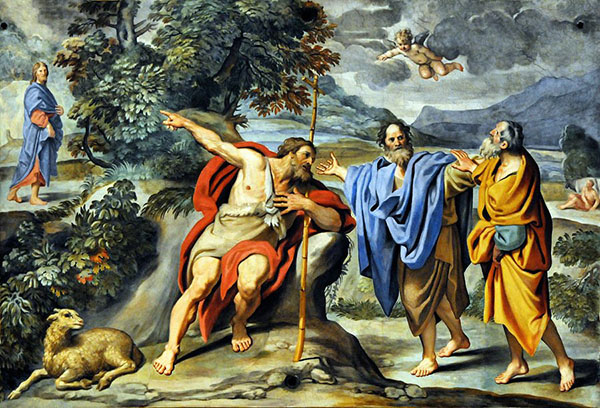
John was standing with two of his disciples,
and as he watched Jesus walk by, he said,
“Behold, the Lamb of God.”
The two disciples heard what he said and followed Jesus.
Jesus turned and saw them following him and said to them,
“What are you looking for?”
They said to him, “Rabbi”which translated means Teacher,
“where are you staying?”
He said to them, “Come, and you will see.”
So they went and saw where Jesus was staying,
and they stayed with him that day.
It was about four in the afternoon.
Andrew, the brother of Simon Peter,
was one of the two who heard John and followed Jesus.
He first found his own brother Simon and told him,
“We have found the Messiah” which is translated Christ.
Then he brought him to Jesus.
Jesus looked at him and said,
“You are Simon the son of John;
you will be called Cephas”which is translated Peter.
Evangelio
Juan 1, 35-42
En aquel tiempo, estaba Juan el Bautista con dos de sus discípulos,
y fijando los ojos en Jesús, que pasaba, dijo:
Este es el Cordero de Dios.
Los dos discípulos, al oír estas palabras, siguieron a Jesús.
Él se volvió hacia ellos, y viendo que lo seguían, les preguntó:
¿Qué buscan?
Ellos le contestaron: ¿Dónde vives, Rabí? (Rabí significa maestro).
Él les dijo: Vengan a ver.
Fueron, pues, vieron dónde vivía y se quedaron con él ese día.
Eran como las cuatro de la tarde.
Andrés, hermano de Simón Pedro,
era uno de los dos que oyeron lo que Juan el Bautista decía y siguieron a Jesús.
El primero a quien encontró Andrés, fue a su hermano Simón,
y le dijo: Hemos encontrado al Mesías (que quiere decir el Ungido).
Lo llevó a donde estaba Jesús
y éste fijando en él la mirada, le dijo:
Tú eres Simón, hijo de Juan. Tú te llamarás Kefás
(que significa Pedro, es decir, roca).
Offertory Antiphon
Shout with joy to God, all the earth;
sing a psalm to his name.
Come hear, all who fear God,
and I will tell you what great things the Lord has done for my soul.
(Psalm 66:1-2, 16)
Antífona de Ofertorio
Aclamad al Señor toda la tierra:
cantad salmos a su nombre:
venid a escuchar, y os narraré, a todos los que teméis a Dios,
cuanto bien ha hecho el Señor a mi alma, aleluya.
(Salmo 65, 2a. 16.)
Communion Antiphon
You have prepared a table before me,
and how precious is the chalice that quenches my thirst.
(Psalm 23:5)
Communion Antiphon 2
We have come to know and to believe
in the love that God has for us.
(1 John 4:16)
Communion Antiphon (Roman Gradual)
We shall rejoice in your salvation;
and in the name of the Lord our God shall we place our pride.
(Psalm 20:6)
Antífona de Comunión
Para mí, Señor, has preparado la mesa
y has llenado mi copa hasta los bordes.
(Salmo 22, 5)
Antífona de Comunión 2
Nosotros hemos conocido el amor que Dios nos tiene
y hemos creído en él.
(1 Juan 4, 16)
Antífona de Comunión (Gradual Romano)
Nos alegraremos con tu salvación
y en el nombre de nuestro Dios alzaremos estandartes.
(Salmo 19, 6)
Lectionary for Mass in the Dioceses of the United States of America, volume I Copyright © 1970, 1997, 1998 Confraternity of Christian Doctrine, Inc., Washington, D.C. All rights reserved. No part of this work may be reproduced or transmitted in any form or by any means, electronic or mechanical, including photocopying, recording, or by any information storage and retrieval system, without permission in writing from the copyright owner.
© 1999 Comisión Episcopal de Pastoral Litúrgica Derechos reservados a favor de OBRA NACIONAL DE LA BUENA PRENSA, A.C. Apartado M-2181. 06000 México, D.F. Orozco y Berra 180. Santa Mariá la Ribera.
© 1970 Comisión Episcopal Española de Liturgia
© 1972 SOBICAIN. Derechos reservados.